Jun 072016
 
The future of the professions

This book predicts the decline of today’s professions and introduces the people and systems that will replace them. In an internet-enhanced society, according to Richard Susskind and Daniel Susskind, we will neither need nor want doctors, teachers, accountants, architects, the clergy, consultants, lawyers, and many others, to work as they did in the 20th century.

The Future of the Professions explains how increasingly capable technologies – from telepresence to artificial intelligence – will place the “practical expertise” of the finest specialists at the fingertips of everyone, often at no or low cost and without face-to-face interaction.

The authors challenge the “grand bargain” – the arrangement that grants various monopolies to today’s professionals. They argue that our current professions are antiquated, opaque and no longer affordable, and that the expertise of their best is enjoyed only by a few. In their place, they propose five new models for producing and distributing expertise in society.

The book raises profound policy issues, not least about employment (they envisage a new generation of “open-collared worker”) and about control over online expertise (they warn of new “gatekeepers”) – in an era when machines become more capable than human beings at most tasks.

[NOTE: This review comes directly from the publisher’s Website].

The future of the professions : How technology will transform the work of human experts. Richard Susskind, Daniel Susskind. Oxford, UK: Oxford University Press, 2016.

Jun 072016
 
13 things mentally strong people don't do

Talk about sound mental health habits to combat those bad habits (13 specific ones) that keep us from getting success. “Developing mental strength”, says the author: “is about improving your ability to regulate your emotions, manage your thoughts, and behave in a positive manner, despite your circumstances.” Whether some people are more predisposed to develop this type of strength, or whether genes, personality or life itself play an important role, you actually must be tough to tackle with grace all the curves that life throws at you. However, it is is not about positive thinking, or ignoring your emotions or feelings, but rather, embracing them, ‘controlling them’.

Personally I can attest to the power of a strong mind (or should we just say, the ‘power of the spirit’?) and this book breaks down into 13 chapters the strategy to become mentally strong, a strategy that indeed has also served me well. Don’t waste time feeling sorry for yourself, don’t give away your power, don’t shy away from change, focus on what you can control, don’t worry about trying to please everyone, take calculated risks in a fearless way, don’t dwell on the past, turn the page, avoid making mistakes over and over, as if you never learned your lesson(s), do not resent other people’s success or talent, and don’t expect immediate results, since even failures are part of the road to success.

13 Things mentally strong people don’t do : Take back your power, embrace change, face your fears, and train your brain for happiness and success. Amy Morin. New York: William Morrow, an imprint of HarperCollinsPublishers, 2014.

Jan 042016
 
Data fluency

Are you fluent in Data? Better yet, are you a good interpreter and communicator of Data? If so, then you possess a great skill: Data Fluency, defined as the “ ability to use the language of data to fluidly exchange and explore ideas within your organization.” This enlightening book is intended as:

  • A roadmap for transforming an organization with a lot of data to one that uses that data to share ideas and knowledge.
  • Practical advice for both consumers and producers of data products (reports, dashboards, analyses). It takes both an effective presenter and a willing audience for the data to flow freely.
  • A guide for executives who are energized by the opportunities to make a smarter organization, but puzzled by their organization’s struggle to be more data-driven.
  • An inventory of the skills and capabilities needed to be data fluent, and an opportunity to see where you stand.

Data fluency : empowering your organization with effective data communication. Zach Gemignani . Indianapolis, IN: John Wiley & Sons, Inc., 2014.

Related Website: Juice Analytics and the Fruition® platform.

Dec 292015
 
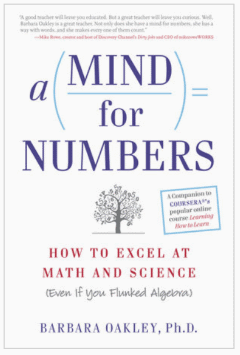
A mind for numbers

This book is more than the story of a dedicated linguist, expert in Russian and Slavic culture, who “by chance”, while in the U.S. Army, was assigned to “become an expert” in radio, cable and telephone switching systems and then electronics training and similar activities apparently unrelated to the art and craft of languages. However, the author tells us how she decided to “retrain” her brain, from math-fobe to math lover. In the same way she learned languages, that is, the better she became at also learning math and science, the more she enjoyed what she was doing to the point she earned a bachelor’s degree in electrical engineering, then a master’s in electrical and computer engineering and finally a doctorate in systems engineering. This “change of heart” (and brain) for the author made her interested in the inner workings of the brain as well, so this book explores how you, as someone who may think that numbers or science is “not your thing” may start thinking and behaving differently. Our habits, our “zombies”, may make us masters of procrastination and conquering this tendency to overconfidence, by being more effective and creative, a better learner, will help you succeed no only in math and sciences. As we approach a new year, 2016, this is perhaps my best recommended reading to start a new year in which, after many attempts to success and to the discovery of your true calling, you could see the light at the end of the tunnel, at that moment in time when you realize you are destined to be great perhaps in a new city, in a new career. Happy New Year to You!

(On the other hand, I always thought that whoever has good linguistic skills can also have good math and science skills, and the reverse is also always true).

A mind for numbers : how to excel at math and science (even if you flunked Algebra). Barbara Oakley, Ph.D.. New York: Penguin Group, 2014.

Dec 272015
 
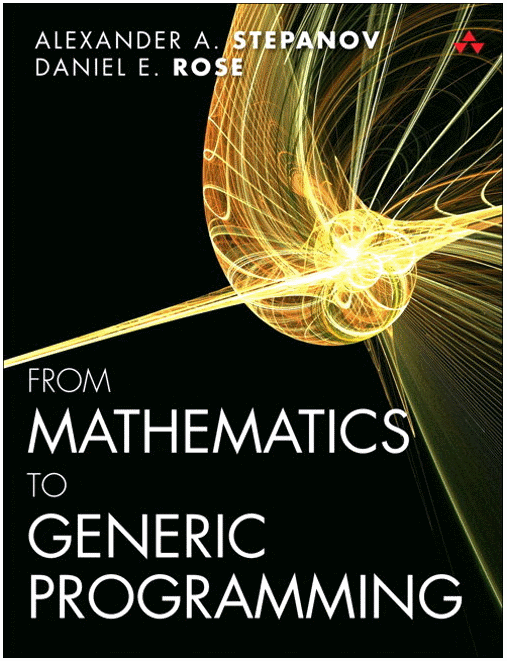
From mathematics to generic programming

All right, this book, written by two high-caliber scientists, is more a textbook than leisure time reading material, unless you are geek enough to go through its pages and try your hand on the algorithms and exercises proposed. However, it could be both, for science and mathematics are actually fun to learn and practice. At any rate is a great companion book for computer science students and practitioners. It tries to bring together computer science and mathematics in theory and praxis, the former greatly influenced by the latter, within the realm of generic programming, a term coined by one of the authors (Stepanov). While reading and applying this book requires some effort, it is intended for “less mathematically advanced readers.” It turns out that many of the fundamental ideas in programming came from mathematics and learning how these ideas evolved over time can be very helpful when you sit down to work on software design. The gist of the book can be summarized as this: “To be a good programmer, you need to understand the principles of generic programming. To understand the principles of generic programming, you need to understand abstraction. To understand abstraction, you need to understand the mathematics on which it’s based.”

From mathematics to generic programming. Alexander A. Stepanov, Daniel E. Rose. New York: Addison-Wesley Professional, 2014.

Nov 302015
 
Books

My catch of the day, found in a public library planted in the middle of a bucolic landscape, is this book about books. In a series of enjoyable and illustrative essays, that read like book reviews across the centuries, the author presents the “50 most influential books in human history.” Although the selection may be debatable considered from a myriad points of view, it is, indeed, a good starting point for whomever decides to try and understand humanity from the perspective of every field of creativity. Each book is set in its historical context, with a clever summary that a lot of college students would love to get their hands on, and a reflection on its wider influence and legacy. The selection starts with The Iliad and ends with Harry Potter and the Philosopher Stone, with The Bible, Kama Sutra, Don Quixote and even some definitely controversial titles in between. This is one of those books that helps you reawaken the pleasure of reading.

Books that changed the world : the 50 most influential books in human history. Andrew Taylor. London: Quercus Books, 2008.

A programming language named after a visionary woman

 Information  Comments Off on A programming language named after a visionary woman
Oct 222015
 
Ada's Algorithm

Over 150 years after the death of Ada Lovelace, a widely-used scientific computer program was named “Ada”. Lovelace, considered the first programmer in history, wrote extensive notes about the machine, including an algorithm to compute a long sequence of Bernoulli numbers, which some observers now consider to be the world’s first computer program. Despite opposition that the principles of science were “beyond the strength of a woman’s physical power of application.”

Augusta Ada King, Countess of Lovelace (1815-1852) was an English mathematician and writer, chiefly known for her work on Charles Babbage‘s proposed mechanical general-purpose computer, the Analytical Engine. She was the first to recognize that the machine had applications beyond pure calculation.

A few years ago, Ada 95 became the first standardized Object‑Oriented Language, upward compatible and thus a strong foundation for building a secure future (currently Ada 2012). Ada is widely used in critical systems such as avionics, railways, banking, military, and healthcare, and it is an excellent teaching language for both introductory and advanced computer science courses.

Ada’s Algorithm : How Lord Byron’s Daughter Ada Lovelace Launched the Digital Age. James Essinger. Brooklyn, New York: Melville House, 2015.

Apr 302015
 
The gospel of food

There is a great number of people in the US, and even in other nations, those emulating everything American, who sincerely believe that low-fat or no fat, low cal or zero calories, and no-sugar-added food is healthy. This not so hard to corrobate fact may have to do with The Gospel of Food, where, on the one hand, consummers, either unknowingly or actually convinced by the daily barrage of commercial and experts appearing in TV morning shows, make sure that their grocery shopping meet the conditions stated above, even going to the other extreme, sometimes influenced, on the other hand, by the diet orthodoxy. The author doesn’t want to fall into the trap of “food perfectionism” neither the readers, in which an opposite stance, that of “nutritional imperialism”, pretends to be the solution to everything, from obesity to feeding the hungry, but according to certain  official guidelines. This is not a simple black and white issue as pointing the finger to the fast-food industry. Chapter 7, for instance, asks what made America fat, and hints that it’s not just the fast food…

The gospel of food : everything you think you know about food is wrong. Barry Glassner. New York : Ecco/HarperCollins Publishers, 2006.

Related Website: Barry Glassner

Apr 302015
 
Life Inc.

I’m sure this book is part of the reading material of some interesting course in many a college or university and it should also be required reading material for any wise consumer in this day and age. “We have come to operate in a world where the market and its logic have insinuated themselves into every area of our lives. (…) and it not just the case of “hip, hypergentrified Brooklynites succumbing to market psychology”, says the author, but people of all walks of life and income levels sucked into the wishful whirlwind of an unsustainable economic illusion of progress and wellbeing. Thoroughly researched, with a wide historic perspective, and full of insight, it makes some rethink their false sense of security in which corporations have become the authority figures. A great reading to understand contemporary history and how it came to be as it is now. [Note: there are at least two different covers of this book, depending on the date of release. The 2009 edition, with a definitely bland cover design, has a slightly different subtitle: “how the world became a corporation and how to take it back.”  The 2011 edition, with the subtitle indicated below, includes “The Life Inc. guide to reclaiming the value you create.”]


Life inc. : how corporatism conquered the world, and how we can take it back
. Douglas Rushkoff. New York: Random House, 2011.

Related Website: Rushkoff.

Apr 242015
 
Unscientific America

In a globalized economy, where nations are vying for science and innovation supremacy, the US can’t afford to think backwards courtesy of religious zealots and opportunist politicians. There is a chapter in this book with the title “The bloggers cannot save us” in which the author begins his reflection about the unsubstantiated information that circulates on the Internet, with a story about some “weblog awards” in different categories, among them, one for the “Best Science Blog”, a few years ago (this book was published back in 2009). In such popularity  contest, the “winners” were an atheist and a former TV meteorologist, a skeptic of human-caused global warming. Apparently, blogs that discuss science in a more accurate and informed fashion have zero chance of winning popularity contests. This is but a sample of the state of scientific literacy in America, tainted with political and religious discourse, at the beginning of the second decade of the 21st century.

Unscientific America : how scientific illiteracy threatens our future. Chris Mooney, Sheril Kirshenbaum. New York : Basic Books, 2009.

Related Website: Unscientific America.