Aug 022017
 
The shallows

This is not just a book about Internet consumerism, but rather a study in neuropsychology which exposes the other dark reality of a tool apparently we can live without: the Internet. The initial question of the author was actually “Is Google making us stupid?” and the gradual loss of our ability to sit down still and browse the pages of a book or a magazine. Besides  the physiological and psychological effects of an addiction to information, how is technology messing up our brains? There are at least “7 ways technology is making you stupid:” First of all, it is screwing up your sleep and your internal clock. Two, it is making you more distracted and and even less efficient academically, if you are a student. Three, there isn’t much you can remember as your long-term memory is not appropriately fed by your transient working memory being continually interrupted. Four, you are more forgetful as multitasking technology keeps you unfocused. Five, you can’t concentrate on what you’re reading since it may get much harder to absorb information wrapped up in a multimedia format. Six, you can’t find your way around without the assistance of GPS as your hippocampus (that component of your brains involved in spatial navigation and the creation of “cognitive maps”) is not exercised. Seven, your brain isn’t unlike the brain of a drug addict or even an alcoholic person if you spend too much time on the Internet. Too much of a good thing can’t be good.

The shallows : what the Internet is doing to our brains. Nicholas Carr. New York: W.W. Norton, 2011.

Related Website: The Shallows. 

Jul 292017
 
Doing data science

There you are: among the many new jobs and jobs descriptions that swarm the labor market, the “new” field of Data Science stands out like a beacon signaling the promised land of a never ending job supply. Yet, this is more than a passing fad, it is simply the realization of everything the evolving information economy always had in store for IT specialists, for the economy itself and for the world at large.

With this information-rich book the authors set out to elucidate how to go beyond the Big Data hype by presenting in a very comprehensive set of chapters everything that is permeated by Data in a globalized world. At the center of it all is the “data scientist”, a data-savvy, quantitative-minded, coding-literate problem solver, who could be part of the solution of the world’s problem, as long as she is part of multidisciplinary teams. The book, intended for experienced data scientists, statisticians, science PhDs, students and those new to data science, among others, wants to describe the current state of data science as well prescribe what data science could be as an academic discipline. This must-have guide includes numerous illustrative code samples and a helpful supplemental reading list that you will definitely need to really get into doing Data Science, for instance, math, coding (R and Python), data analysis and statistical inference, artificial intelligence and machine learning, experimental design and visualization.

Doing data science : straight talk from the frontline. Cathy O’Neil, Rachel Schutt. Sebastopol, CA.: O’Reilly Media, 2013. First Edition.

Dec 162016
 
Big data

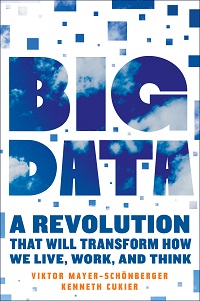
In the beginnings of the information era, “data” was simply a collection of facts organized and represented in a suitable form for processing by a computer. Along came the “relational database management systems” or RDMS that since the 1980s constitute the database model, i.e. rows and columns neatly organized in tables and then these tables interrelated to each other, which is the predominant form of storage, even today, of any type of information. The revolution, or rather, evolution, that big data encompasses has to do with the power of connecting and associating disparate pieces of information in a vast sea of data such as the Internet. “The real revolution is not in the machines that calculate data but in data itself and how we use it” but most importantly how scientists, companies and ordinary people will make decisions and try to interpret reality in ways that no longer are subject to a predetermined worldview. Social media, like Facebook, Twitter, LinkedIn and their astronomical number of “interactions” among users all over the world, every single second of the day, produces, generates, begets, in fact, “big data.” On a side note, we should say that this book would have benefited of an introduction explaining the title of each one of its 10 chapters or simply the editorial orientation intended: Now, More, Messy, Correlation, Datafication, Value, Implications, Risks, Control, Next.

Big data : a revolution that will transform how we live, work, and think. Viktor Mayer-Schönberger and Kenneth Cukier. New York City: An Eamon Dolan Book. Houghton Mifflin Harcourt, 2013.

Jan 042016
 
Data fluency

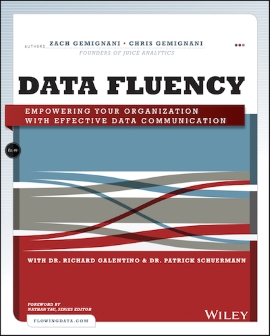
Are you fluent in Data? Better yet, are you a good interpreter and communicator of Data? If so, then you possess a great skill: Data Fluency, defined as the “ ability to use the language of data to fluidly exchange and explore ideas within your organization.” This enlightening book is intended as:

  • A roadmap for transforming an organization with a lot of data to one that uses that data to share ideas and knowledge.
  • Practical advice for both consumers and producers of data products (reports, dashboards, analyses). It takes both an effective presenter and a willing audience for the data to flow freely.
  • A guide for executives who are energized by the opportunities to make a smarter organization, but puzzled by their organization’s struggle to be more data-driven.
  • An inventory of the skills and capabilities needed to be data fluent, and an opportunity to see where you stand.

Data fluency : empowering your organization with effective data communication. Zach Gemignani . Indianapolis, IN: John Wiley & Sons, Inc., 2014.

Related Website: Juice Analytics and the Fruition® platform.

Dec 272015
 
From mathematics to generic programming

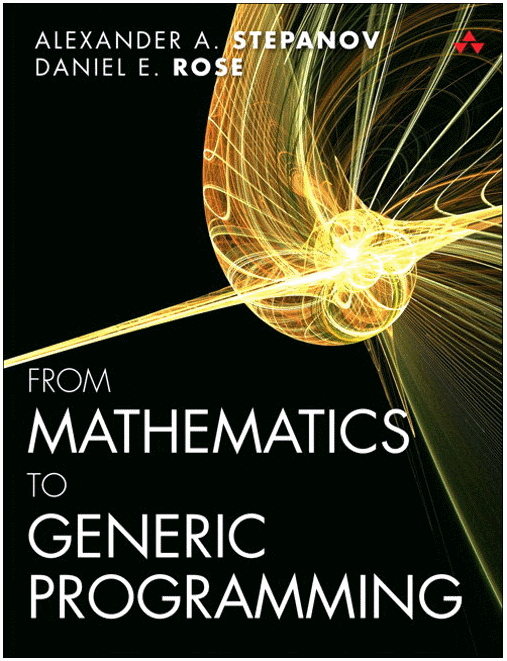
All right, this book, written by two high-caliber scientists, is more a textbook than leisure time reading material, unless you are geek enough to go through its pages and try your hand on the algorithms and exercises proposed. However, it could be both, for science and mathematics are actually fun to learn and practice. At any rate is a great companion book for computer science students and practitioners. It tries to bring together computer science and mathematics in theory and praxis, the former greatly influenced by the latter, within the realm of generic programming, a term coined by one of the authors (Stepanov). While reading and applying this book requires some effort, it is intended for “less mathematically advanced readers.” It turns out that many of the fundamental ideas in programming came from mathematics and learning how these ideas evolved over time can be very helpful when you sit down to work on software design. The gist of the book can be summarized as this: “To be a good programmer, you need to understand the principles of generic programming. To understand the principles of generic programming, you need to understand abstraction. To understand abstraction, you need to understand the mathematics on which it’s based.”

From mathematics to generic programming. Alexander A. Stepanov, Daniel E. Rose. New York: Addison-Wesley Professional, 2014.

Nov 302015
 
Books

My catch of the day, found in a public library planted in the middle of a bucolic landscape, is this book about books. In a series of enjoyable and illustrative essays, that read like book reviews across the centuries, the author presents the “50 most influential books in human history.” Although the selection may be debatable considered from a myriad points of view, it is, indeed, a good starting point for whomever decides to try and understand humanity from the perspective of every field of creativity. Each book is set in its historical context, with a clever summary that a lot of college students would love to get their hands on, and a reflection on its wider influence and legacy. The selection starts with The Iliad and ends with Harry Potter and the Philosopher Stone, with The Bible, Kama Sutra, Don Quixote and even some definitely controversial titles in between. This is one of those books that helps you reawaken the pleasure of reading.

Books that changed the world : the 50 most influential books in human history. Andrew Taylor. London: Quercus Books, 2008.

A programming language named after a visionary woman

 Information  Comments Off on A programming language named after a visionary woman
Oct 222015
 
Ada's Algorithm

Over 150 years after the death of Ada Lovelace, a widely-used scientific computer program was named “Ada”. Lovelace, considered the first programmer in history, wrote extensive notes about the machine, including an algorithm to compute a long sequence of Bernoulli numbers, which some observers now consider to be the world’s first computer program. Despite opposition that the principles of science were “beyond the strength of a woman’s physical power of application.”

Augusta Ada King, Countess of Lovelace (1815-1852) was an English mathematician and writer, chiefly known for her work on Charles Babbage‘s proposed mechanical general-purpose computer, the Analytical Engine. She was the first to recognize that the machine had applications beyond pure calculation.

A few years ago, Ada 95 became the first standardized Object‑Oriented Language, upward compatible and thus a strong foundation for building a secure future (currently Ada 2012). Ada is widely used in critical systems such as avionics, railways, banking, military, and healthcare, and it is an excellent teaching language for both introductory and advanced computer science courses.

Ada’s Algorithm : How Lord Byron’s Daughter Ada Lovelace Launched the Digital Age. James Essinger. Brooklyn, New York: Melville House, 2015.

Apr 302015
 
The gospel of food

There is a great number of people in the US, and even in other nations, those emulating everything American, who sincerely believe that low-fat or no fat, low cal or zero calories, and no-sugar-added food is healthy. This not so hard to corrobate fact may have to do with The Gospel of Food, where, on the one hand, consummers, either unknowingly or actually convinced by the daily barrage of commercial and experts appearing in TV morning shows, make sure that their grocery shopping meet the conditions stated above, even going to the other extreme, sometimes influenced, on the other hand, by the diet orthodoxy. The author doesn’t want to fall into the trap of “food perfectionism” neither the readers, in which an opposite stance, that of “nutritional imperialism”, pretends to be the solution to everything, from obesity to feeding the hungry, but according to certain  official guidelines. This is not a simple black and white issue as pointing the finger to the fast-food industry. Chapter 7, for instance, asks what made America fat, and hints that it’s not just the fast food…

The gospel of food : everything you think you know about food is wrong. Barry Glassner. New York : Ecco/HarperCollins Publishers, 2006.

Related Website: Barry Glassner

Apr 242015
 
Unscientific America

In a globalized economy, where nations are vying for science and innovation supremacy, the US can’t afford to think backwards courtesy of religious zealots and opportunist politicians. There is a chapter in this book with the title “The bloggers cannot save us” in which the author begins his reflection about the unsubstantiated information that circulates on the Internet, with a story about some “weblog awards” in different categories, among them, one for the “Best Science Blog”, a few years ago (this book was published back in 2009). In such popularity  contest, the “winners” were an atheist and a former TV meteorologist, a skeptic of human-caused global warming. Apparently, blogs that discuss science in a more accurate and informed fashion have zero chance of winning popularity contests. This is but a sample of the state of scientific literacy in America, tainted with political and religious discourse, at the beginning of the second decade of the 21st century.

Unscientific America : how scientific illiteracy threatens our future. Chris Mooney, Sheril Kirshenbaum. New York : Basic Books, 2009.

Related Website: Unscientific America.

Mar 242015
 
Information Diet

Have you come across folks carrying an iPad or a smartphone and “reading” the news or simply browsing, but not reading, a huge number of publications? Not to mention the proud feeling of just being the owners of one (or more) of these extraordinary gadgets? Well, whether you are carring a tablet or a laptop computer, or sitting at home or office in front of an Internet browser, that will undoubtedly put a humongous amount of information (and misinformation) readily available to you in an instant. However, that does not change the fact that you still have to read it and digest it. The whole process has not changed, but “Information overconsumption” is what permeates our society. You still need to have good “information habits” in your “information diet” in order to avoid getting Information Obesity, and the goal of the author, Clay A. Johnson, is to show you how, whether you are a “liberal” or a “conservative”. Johnson, a former transparency advocate in Washington D.C., draws a clever parallel between our food consumption and our information consumption (hence, for instance, the theme of the book cover), and he believes that this is just not a fancy metaphor but a harsh reality and that a “conscious consumption of information is possible”, lest more and more proofs of information indigestion keep cropping up in the media, like that oxymoronic protest sign that read: Keep your government hands off my Medicare. Learn more about the incongruences that even people considered intelligent and educated utter in public more often than not, as just one of the many symptoms of this modern epidemic.

The information diet: a case for conscious consumption. Clay A. Johnson. Sebastopol, CA: O’Reilly Media Inc., 2012. First edition, second release.